


Table of Contents
- What is a Pressure Relief Valve?
- What Does a PRV Valve Do?
- How Does a Pressure Relief Valve Work?
- Terms You Will See on a PRV Datasheet
- Types of Pressure Relief Valves
- Where Pressure Relief Valves Are Used
- Installing and Isolating a PRV
- How to Select a Pressure Relief Valve
- Common PRV Problems and What Causes Them
- Conclusion
- FAQs
Every pressurised system has a limit. A pump keeps running after an outlet blocks, a heat source keeps firing, a compressor keeps loading, and pressure climbs past the number the vessel was designed for. One component stands between that climb and a rupture, and it works without power, without a signal, and without an operator watching the gauge.
What is a Pressure Relief Valve?
A pressure relief valve is a safety device that opens automatically when system pressure reaches a preset limit, releases enough fluid to bring pressure back down, and closes again once the system is safe. It needs no electricity or control signal. Spring force alone holds it shut, and fluid pressure alone opens it.
Engineers shorten the name to PRV. You will also see relief valve, safety valve, and safety relief valve used for the same family of products, though the three describe slightly different behaviour, covered below.
What Does a PRV Valve Do?
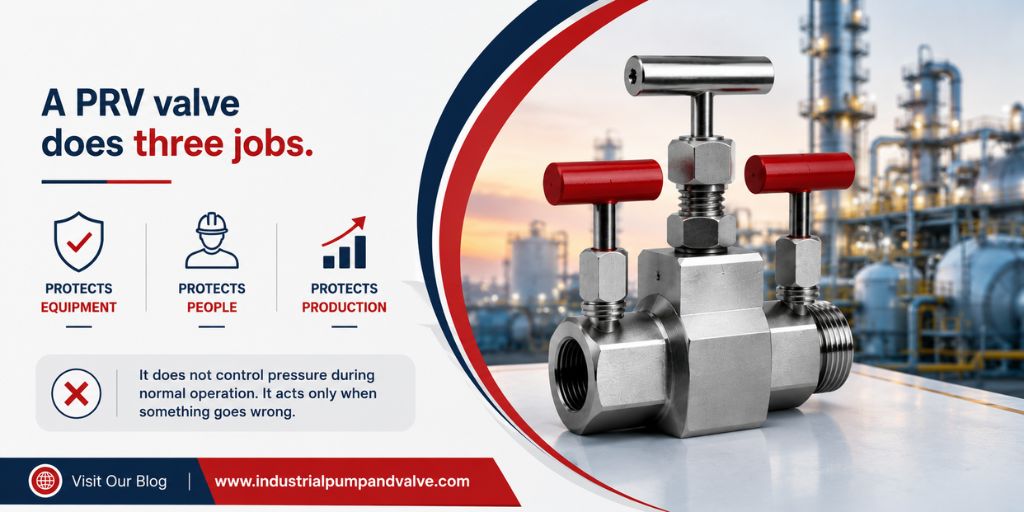
It protects equipment:
Vessels, pipelines, pumps, and heat exchangers all carry a maximum allowable working pressure. The PRV keeps the system under that figure.
It protects people:
A ruptured vessel throws metal and hot fluid. Overpressure protection remains the single control standing between a process upset and an injury.
It protects production:
Replacing a burst exchanger costs weeks. A relief valve that lifts, vents, and reseats costs an inspection.
Note: what a PRV valve does not do. It does not control pressure during normal running. That job belongs to a regulator or a control valve. The PRV sits quiet for years and acts only when something else has already gone wrong.
How Does a Pressure Relief Valve Work?
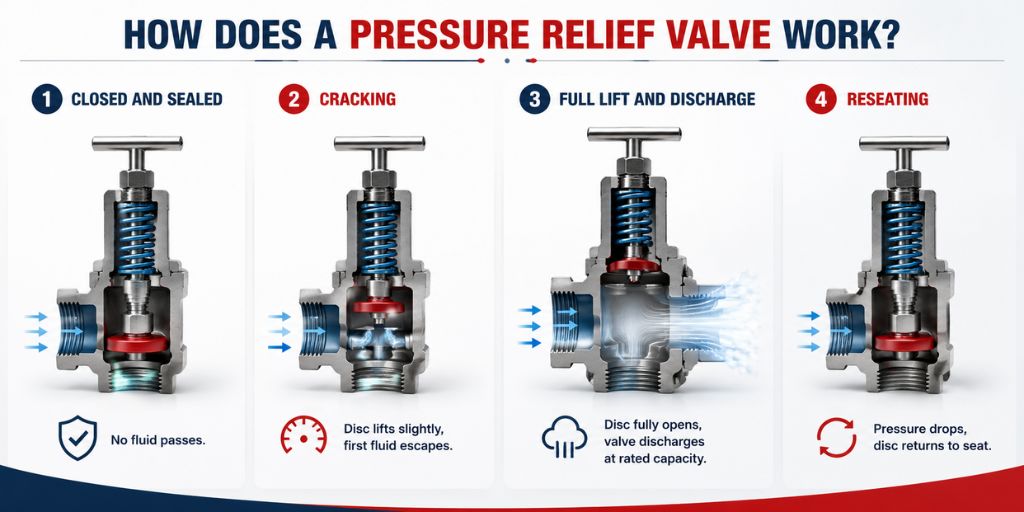
Stage 1: Closed and sealed
A spring presses a disc against a seat. As long as inlet pressure stays below the spring force, the seal holds, and no fluid passes. A technician sets this spring load on a test bench, and the resulting figure becomes the set pressure.
Stage 2: Cracking
Inlet pressure rises until it matches the spring force. The disc lifts off the seat by a small amount, and the first fluid escapes. This point is called cracking pressure. On liquid service, the valve opens gradually from here.
Stage 3: Full lift and discharge
Pressure keeps climbing a little past the set point. On gas and steam service, escaping fluid strikes the blowdown ring and pushes the disc fully open in one snap action, called pop action. The valve now passes its rated capacity, and pressure in the system starts to fall.
Stage 4: Reseating
Pressure drops. Once it falls far enough below the set pressure, spring force wins again and the disc returns to the seat. The gap between set pressure and reseating pressure is the blowdown, usually between 4 and 10 percent of set pressure.
Terms You Will See on a PRV Datasheet
| Term | Meaning |
|---|---|
| Set pressure | Pressure at which the valve is set to open |
| Cracking pressure | Point where the first leakage past the seat begins |
| Overpressure | Rise above set pressure needed to reach full lift, often 10 percent |
| Blowdown | Pressure drop below set point before the valve reseats |
| Backpressure | Pressure at the outlet, which shifts the effective set point on conventional valves |
| Relieving capacity | Flow the valve passes at full lift, stated in kg/hr or LPM |
Backpressure trips up more buyers than any other item on this list. If the discharge line feeds a header shared with other valves, ask for a balanced bellows or pilot-operated design.
Types of Pressure Relief Valves
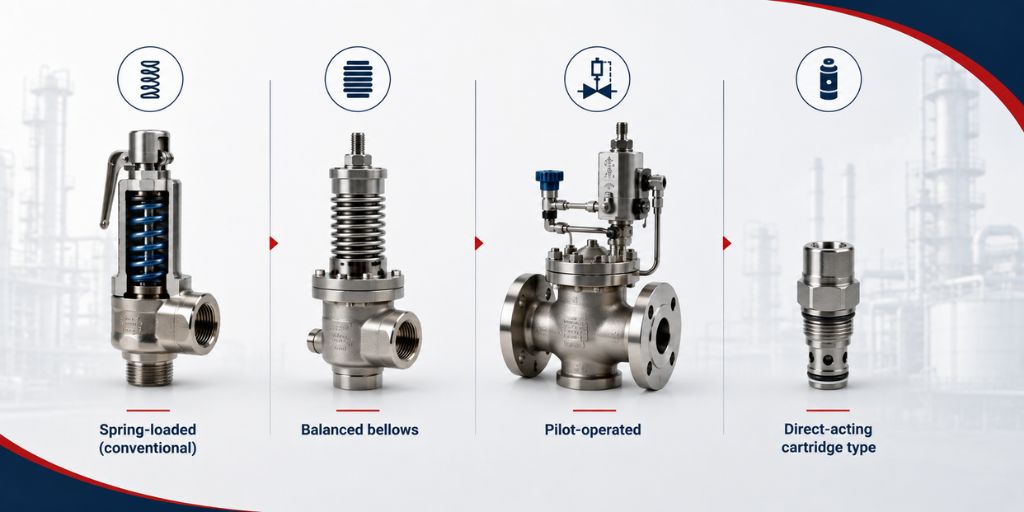
Spring-loaded (conventional):
A plain spring and disc. Low cost, simple, and the default for most plant service. Backpressure affects the set point.
Balanced bellows:
A bellows isolates the spring chamber from outlet pressure, so the set point holds steady even when backpressure varies.
Pilot-operated:
Process pressure itself holds the main valve shut through a pilot. These handle set pressures close to operating pressure and give tight seating.
Direct-acting cartridge type:
Compact units used in hydraulic circuits, test rigs, and instrumentation panels.
Where Pressure Relief Valves Are Used
Chemical process lines carry reactive fluids where a runaway reaction raises pressure faster than any operator can respond. Boilers and steam headers need certified valves by statute. Oil and gas separators, compressor discharge lines, and pipeline stations all carry relief protection at every pressure step.
Instrumentation and sampling panels use compact high pressure PRVs to guard transmitters and gauges. Hydro testing benches need them too, since a test pump can push pressure well past the rating of whatever sits on the bench if nothing caps the rise.
Pharmaceutical, food, water treatment, and power plants follow the same pattern.
Installing and Isolating a PRV
Two details decide whether the valve performs the way the datasheet says.
Inlet line:
Keep it short and full bore. Pressure drop across a long or undersized inlet causes the valve to open and slam shut repeatedly.
Isolation:
A relief valve comes off the line for bench testing every cycle, so plan a block valve underneath it. Most plants fit a full-bore ball valve there and lock it open during normal running. For test rigs and instrumentation panels, a high pressure ball valve manufacturer can supply units rated to match the PRV itself.
Mount the valve upright. A tilted spring housing changes the load on the disc.
How to Select a Pressure Relief Valve
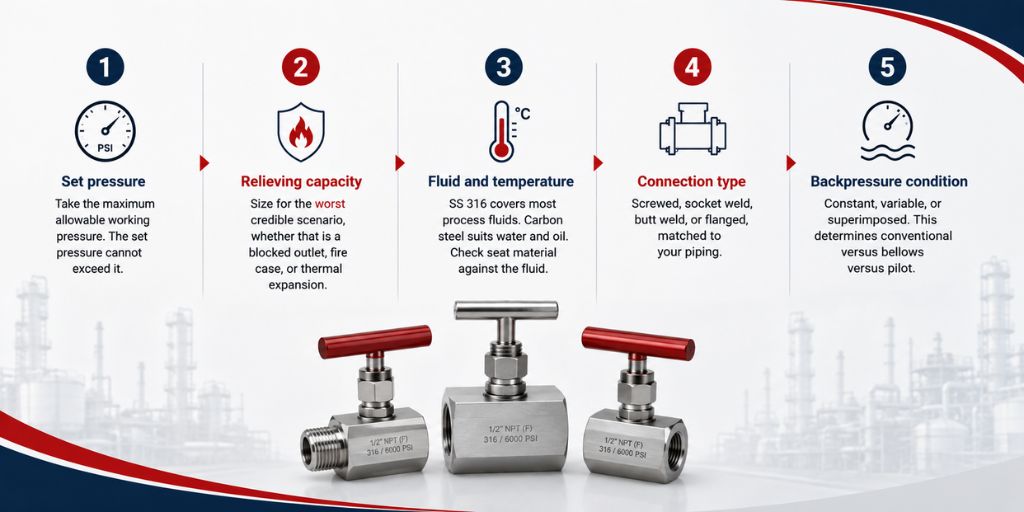
Work through five items before raising an enquiry.
- Set pressure: Take the maximum allowable working pressure of the protected equipment. The set pressure cannot exceed it.
- Relieving capacity: Size for the worst credible scenario, whether that is a blocked outlet, fire case, or thermal expansion.
- Fluid and temperature: SS 316 covers most process fluids. Carbon steel suits water and oil. Check seat material against the fluid.
- Connection type: Screwed, socket weld, butt weld, or flanged, matched to your piping.
- Backpressure condition: Constant, variable, or superimposed. This determines conventional versus bellows versus pilot.
Our high-pressure PRV range runs to 14,500 PSI (1000 bar) in sizes from 1/4 inch to 2 inch, built in SS 316, SS 316L, SS 304, and carbon steel with PTFE packing. Fix the fluid and the backpressure condition first, then talk to the set point with your pressure relief valve manufacturer, because seat material and packing often change once the service is confirmed.
Common PRV Problems and What Causes Them
Chatter: The valve opens and slams shut in rapid cycles. Usually an oversized valve or an inlet line with too much pressure drop.
Seat leakage: Operating pressure sits too close to the set pressure, so the seat never fully unloads. Pilot-operated designs solve this.
Failure to lift: Corrosion or scale has seized the disc. Regular bench testing catches it.
Backflow from a shared header: When several relief valves discharge into one header, fluid from a relieving valve can push back into the outlet of a closed one. A check element on each branch stops it, and any non return valve manufacturer can supply the right size against your header pressure.
Wrong set pressure after service: Any valve that comes off the line goes back only after a fresh test and a new seal.
Conclusion
A pressure relief valve does nothing on most days and everything on the worst one. Size it against a real scenario, match the material to the fluid, account for backpressure, and test it on schedule.
Industrial Pump and Valve is an industrial valve manufacturer in Ahmedabad, and along with valves, we are one of the best industrial pump manufacturers in India. Our valves carry CE and ISO certification, and we have supplied pressure control equipment to chemical, refinery, power, and process plants since 2006.
If you need help selecting the right pressure relief valve for your application, contact us today. Our team can help you choose a suitable valve based on pressure, fluid, temperature, connection type, and backpressure conditions. You can reach us at +91 9328289287 or email info@ambicamachinetools.com for product details and assistance.
FAQs
What is a PRV valve?
A PRV valve, or pressure relief valve, is a safety device that opens automatically when pressure reaches a preset limit and closes once pressure returns to normal. It needs no power supply and operates on spring force alone.
What does a PRV valve do?
It vents excess fluid from a system to keep pressure below the maximum allowable working pressure of the equipment, protecting vessels, pipelines, and operators from an overpressure failure.
What is the difference between a pressure relief valve and a safety valve?
A relief valve opens gradually as pressure rises, which suits liquids. A safety valve pops fully open in one action, which suits gas and steam. A safety relief valve handles both.
At what pressure does a relief valve open?
At its set pressure, which a technician fixes on a test bench. Full lift usually needs around 10 percent overpressure above the set point.
How often should a pressure relief valve be tested?
Most plants bench test annually, and critical or fouling service more often. Follow the standard that applies to your equipment and your local statutory requirement.
Can a pressure relief valve be repaired?
Yes. Seats and springs are replaceable, but the valve must be reset and tested before it goes back into service, and it needs a new seal.